Chair-Side Whitening
Questions for dental practices about chair-side whitening with PAP: procedure, duration, delegating to the practice team, equipment, enamel and comparison with hydrogen peroxide.
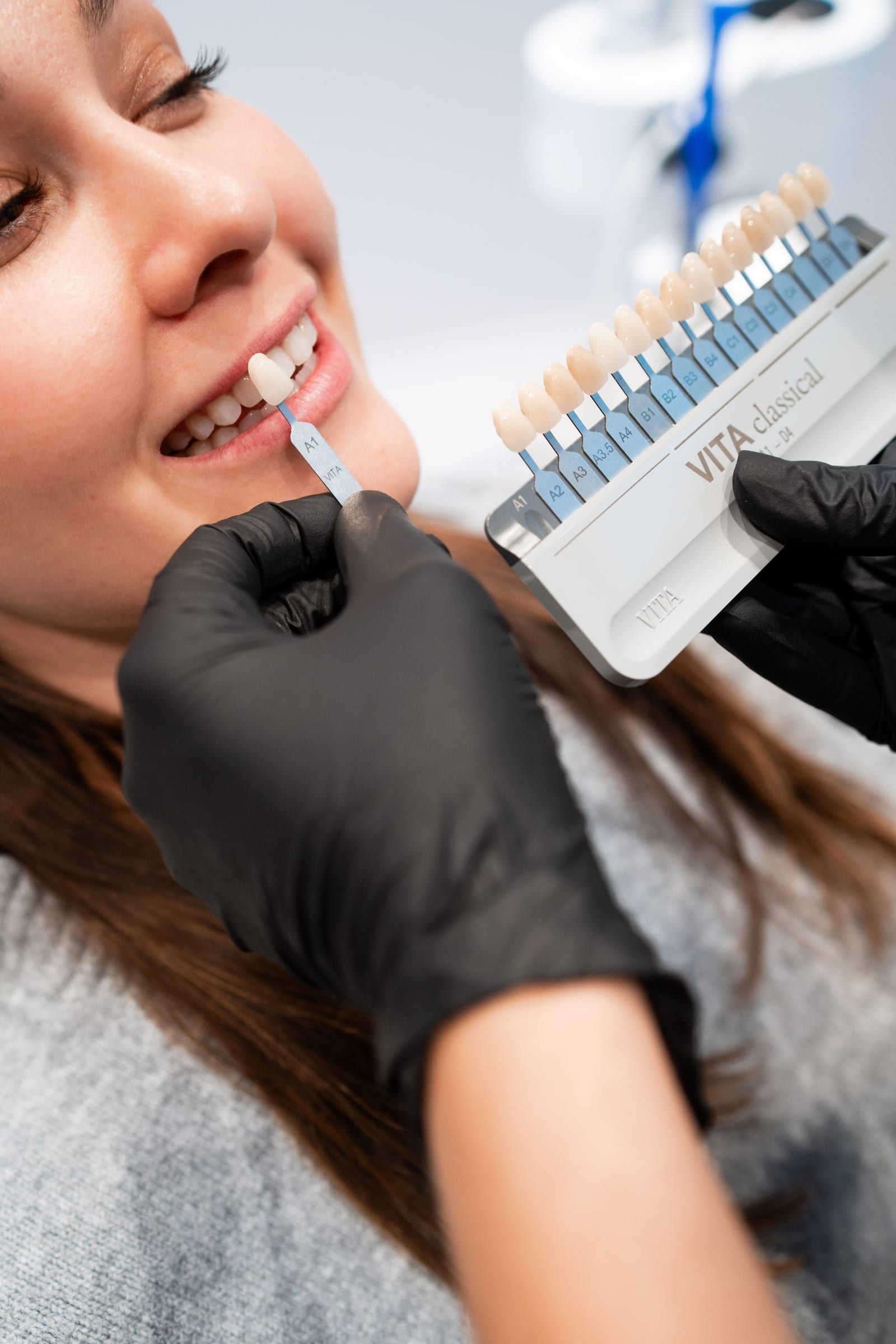
The Chair-Side Whitening System with 13% PAP consists of a gel and a Whitening Activator. The two components are mixed directly before use. This is how the treatment works:
- Colour assessment: You determine the starting tooth colour together with your patient.
- Gum protection: The gums are covered with cotton rolls and a gingival barrier.
- Mixing and applying: For each cycle, you open a gel pot, add the activator, mix both and apply the gel to the teeth.
- Exposure and suction: The gel works for 15 minutes and is then removed with a suction cannula. You repeat this cycle four times in total.
- Finishing: You rinse the oral cavity with water, remove the gingival barrier and the cotton rolls and determine the tooth colour again.
Detailed instructions for use come with the system.
The treatment takes place in one session. The gel works in four cycles of 15 minutes each, so 60 minutes in total. On top of that come the colour assessment at the beginning and end, and placing and removing the gingival barrier.
No impressions, no lab work and no follow-up appointment are needed. The treatment therefore fits well into your existing appointments, for example straight after a hygiene appointment.
The protocol is simple and can be fully delegated to your practice team. The treatment can be carried out by dentists, dental hygienists or prophylaxis assistants.
Before whitening, you check as usual that the teeth and gums are healthy. After that, your team can carry out the treatment independently, without an extra training day.
No. You do not need a whitening lamp or any new equipment. The gel works without light.
Everything else is already in your practice: cotton rolls for gum protection, a suction cannula to remove the gel and water for rinsing. Because the protocol is so simple, you can delegate the treatment to your prophylaxis team.
No. In independent laboratory tests, including at Empa (Swiss Federal Laboratories for Materials Science and Technology), the enamel showed the following after treatment with our technology:
- Surface: no erosive changes.
- Roughness: no significant increase compared with untreated enamel.
- Surface hardness: only negligible changes.
In the same tests, a product with 40% hydrogen peroxide changed the surface morphology, significantly increased the roughness and reduced the hardness near the surface.
The reason lies in the mode of action: PAP oxidises the colour molecules primarily at the enamel surface and penetrates much less deeply. The technology has also been studied by the Fraunhofer Institute.
With PAP, your patients achieve a natural white. In laboratory tests, our technology effectively whitened enamel samples, compared with conventional in-office products with hydrogen peroxide.
The difference lies in how they work:
- High-strength hydrogen peroxide penetrates through enamel and dentin to near the pulp. This allows very strong whitening, but often leads to temporary hypersensitivity.
- PAP works primarily at the enamel surface. Sensitivity therefore occurs much less often.
For very deep, stubborn stains, hydrogen peroxide can be the stronger option. For this, we offer our Whitening Trays with 6% hydrogen peroxide for use at home.
No suitable answer found?
Do not hesitate to contact us. We will reply as soon as possible.