What are cavities and how do they affect your teeth?
Tooth decay is one of the most common dental diseases worldwide. It starts when bacteria in your mouth produce acids that attack the tooth surface. The enamel loses minerals, and the first sign is often a white spot, the earliest stage of a cavity. Left untreated, decay can spread deeper into the tooth and lead to pain and more serious dental problems.
What role does fluoride play in preventing cavities?
Fluoride plays a central role in cavity prevention. It strengthens tooth structure and supports the remineralisation of enamel. You will find it in toothpastes and mouthwashes, as well as in professional treatments such as fluoride varnish. Fluoride forms a protective barrier on the enamel that helps fend off acid attacks and reduces mineral loss.
Fluoride varnish: a proven method at the dentist
Dentists often use fluoride varnish for concentrated protection against cavities. The varnish is painted onto the clean tooth surface, dries quickly and forms a lasting protective layer. Over time it releases fluoride ions that support the remineralisation of enamel and make teeth more resistant to decay.
Fluoride is known to cause a rather superficial remineralisation that halts the cavity. When fluoride products are combined with good oral hygiene, early cavities became inactive in around 35% of cases.
Dental gels: an alternative to traditional methods
Some newer approaches use a special dental gel with alternative active ingredients such as hydroxyapatite or natural enzymes. These imitate the protective function of saliva and strengthen the tooth surface. Such gels help protect against cavities and support the natural whiteness of your teeth, without harsh bleaching agents or fluoride.
Curodont Repair: treating early cavities without drilling
Curodont Repair, developed by Vvardis (formerly Credentis AG), is a turning point in how early tooth decay is treated. It tackles early cavities without drilling, using the principle of Guided Enamel Regeneration, which encourages enamel to rebuild naturally. The treatment is fluoride-free, so it suits people who want or need to avoid fluoride.
The science behind Curodont Repair
Curodont Repair is based on the self-assembling peptide P11-4, a molecule that binds specifically to areas of demineralised enamel. The peptide comes from biotechnological research carried out in Germany and Switzerland.
How does Curodont Repair work?
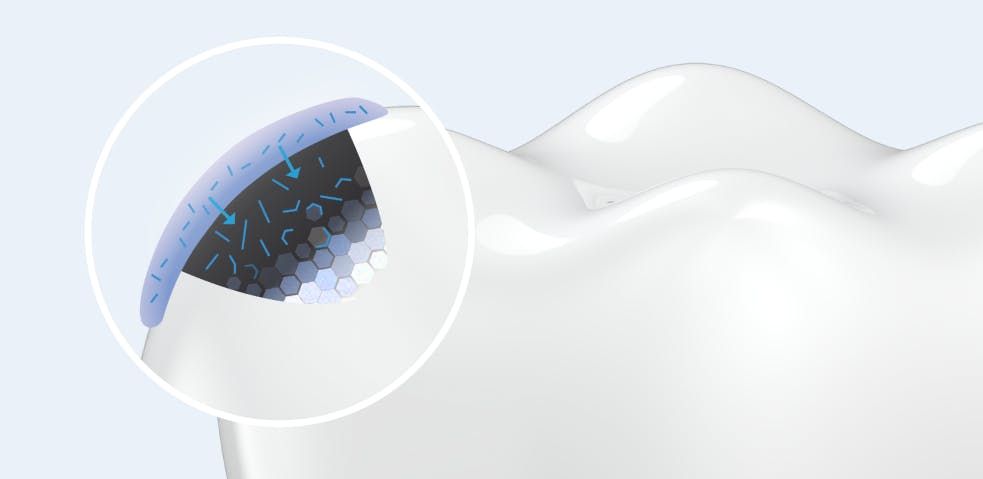
Once the P11-4 molecule has attached to the demineralised area, it forms a biomatrix. This matrix acts as a template that supports the natural rebuilding of enamel. Phosphate ions play a central role: together with calcium naturally present in saliva, they help form hydroxyapatite crystals, the main building blocks of enamel and essential for restoring tooth structure.
Remineralisation and white spots
The remineralisation promoted by Curodont Repair is a dynamic process. It halts the progression of early cavities, helps strengthen the tooth and can improve its appearance by reducing white spots. These spots are often the first visible sign of decay and can be treated effectively through remineralisation.
Research behind the treatment
Researchers, including Lysek and Alkilzy, continue to study the mechanisms behind tooth decay. Their work helps improve products such as Curodont Repair and the way early cavities are treated.
What is the treatment like in practice?
Applying Curodont Repair is quick and simple and can be done during a regular dental appointment. It is a minimally invasive option for people with early signs of decay and an alternative to traditional cavity treatment. Ask your dentist or dental hygienist whether it is suitable for you.
Does it work? Clinical studies on Curodont Repair
The efficacy of Curodont Repair has been shown in numerous clinical studies. Patients report a clear improvement in dental health and a reduction in cavity lesions without invasive treatment.
A recent randomised, controlled study compared Curodont Repair with traditional fluoride varnish for early cavities. It showed that Curodont Repair not only promotes remineralisation but also significantly reduces the progression of cavities. After six months, the Curodont Repair group had a 60% lower likelihood of cavity progression than the fluoride varnish group. This suggests Curodont Repair is more effective than fluoride varnish alone, especially in the early stages of decay.
Another study examined whether Curodont Repair can remineralise deeper layers of cavity lesions. It found that the treatment forms a scaffold structure that supports natural mineralisation by saliva, allowing deeper remineralisation of the enamel.


 Dental Health