Toothpaste usage statistics: how much do people use?
Millions of people reach for toothpaste every day. It is a small habit, but it shows how much we value oral hygiene, and how many choices exist to suit different needs and preferences around the world.
- In 2020, over 71 million Americans brushed their teeth with toothpaste at least four times a day on average [4].
- One study found that people in Costa Rica used an average of 466 grams of toothpaste each, and people in Brazil about 456 grams per person [12].
- In 2020, about 139.37 million people in the U.S. used Colgate [5].
- In 2020, about 17.64 million people in Great Britain preferred whitening toothpastes, making them the top choice. Around 16.2 million chose regular toothpastes [7].
How much toothpaste do children swallow?
A study published in Caries Research set out to measure how much toothpaste preschool children use and swallow. The researchers worked out the amount swallowed by subtracting the amount spat out from the amount used [8]. They found:
- For 66% of the children, the amount of toothpaste used from one brushing to the next differed by less than 0.250 grams [8].
- For 69% of the children, the amount accidentally swallowed each time was less than 0.100 grams [8].
- Across the three brushing sessions compared, there was no big difference in how much toothpaste was used or swallowed [8].
Toothpaste use in French families
A study in Food and Chemical Toxicology looked at how much toothpaste French families use and how much they are exposed to, letting them use their usual toothpaste at home as normal [15]. Older people tend to brush more often and use more toothpaste each time, but their exposure per kilogram of body weight falls with age [15].
- Children aged 2 to 6 had the highest exposure, up to 8.2 milligrams per kilogram of body weight per day [15].
- For adults, exposure was 2.8 milligrams per kilogram of body weight per day [15].
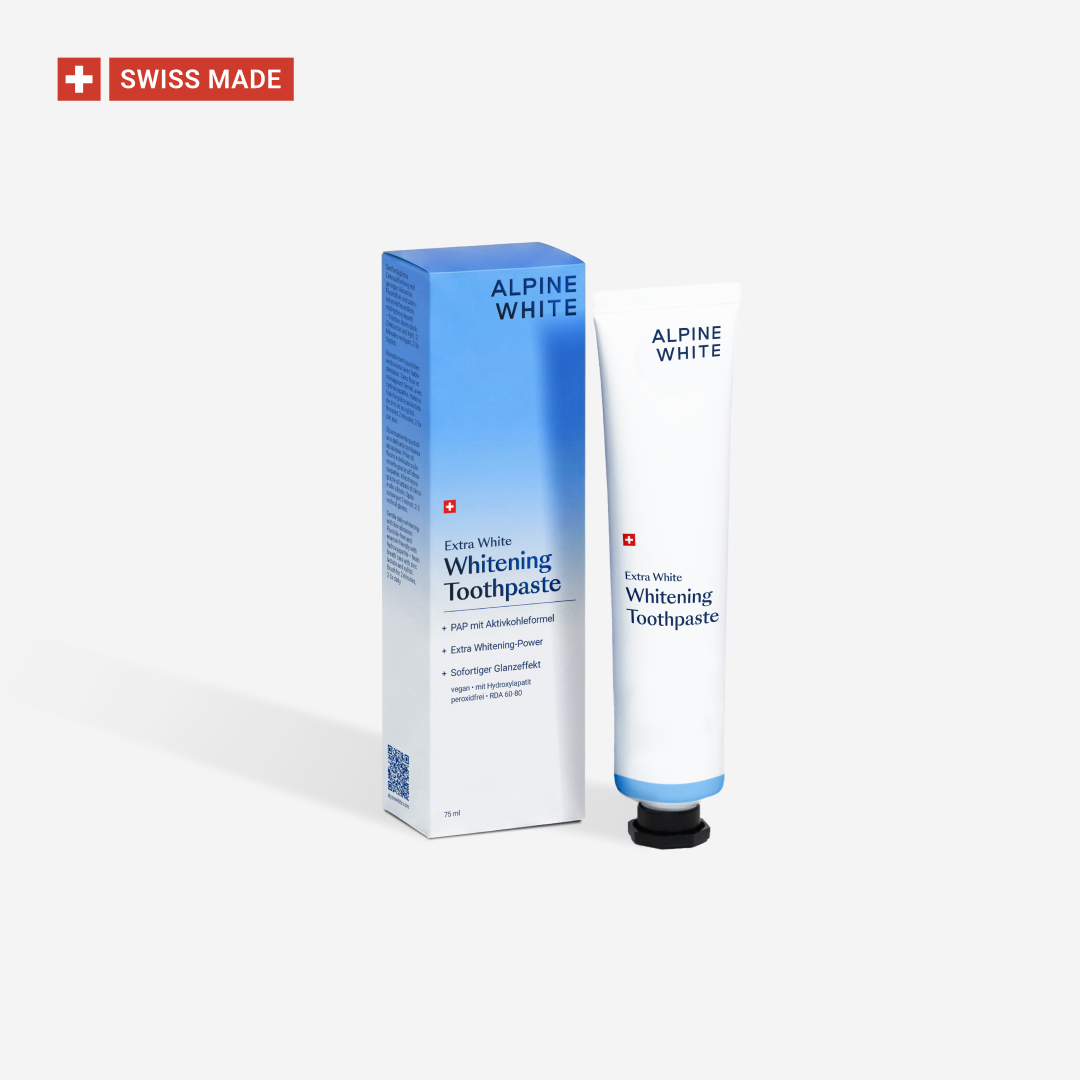
In short, toothpaste is part of almost everyone's daily routine, and how much we use depends on the person. If you want a whiter smile without harming your enamel, our Swiss-made Alpine White Whitening Toothpaste Extra White is designed to do exactly that, in a simple and effective way.
Toothpaste market statistics: size, brands and trends
Billions of tubes are sold every year. Toothpaste is an everyday essential, and the range on offer reflects every taste and need.
- The global market is projected to grow from $34.48 billion in 2024 to $50.78 billion by 2029, an annual growth rate of 8.05% [6].
- Another source expects the worldwide market to reach $18.3 billion by 2025, driven by growing awareness of oral hygiene, a growing population and the launch of reasonably priced new toothpastes [2].
- Because of the risk of dental fluorosis in young children, demand for fluoride-free toothpaste is rising [2].
- More than 35% of people worldwide have tooth sensitivity, boosting demand for potassium nitrate toothpaste. Interest in whiter teeth has also made tartar control and whitening toothpastes popular [2].
- After negative reports about triclosan and the FDA's ban on it in soaps, more people prefer toothpaste without triclosan [2].
- In 2022, U.S. store sales of toothpaste reached about $3.36 billion [9].
Who leads the toothpaste market?
A study in the Journal of Economics and Public Finance profiled the U.S. toothpaste market using store sales data from 2007 and 2008. It found four main groups of competitors based on price and quality [10]:
- Procter & Gamble led with Crest, which held 34.7% of the market in the middle price group at $2.99 per tube. That is slightly more than Colgate, which cost $2.86 [10].
- Colgate-Palmolive came second, with Colgate at 33.5% and Ultrabrite at 0.5% [10].
- The middle group included GlaxoSmithKline, with Aquafresh (7.1%) and Sensodyne (6.8%), and Church & Dwight, with Arm & Hammer (5.2%) and Aim (0.7%) [10].
- The smaller players were Tom's of Maine at 1.7% and Unilever with Mentadent (1.1%), Close-Up (0.6%) and Pepsodent (0.4%) [10].
- In 2008, on average, 37.2% of toothpaste was sold through promotions. Aquafresh targeted the budget market and still needed big discounts to hold its position [10].
The companies behind the brands
- Procter & Gamble made $67 billion in sales in 2018. Crest, part of its Health Care category, contributed 13% of that [10].
- Colgate-Palmolive sold $15.5 billion of products worldwide in 2018. Colgate toothpaste comes from its Oral Care Division [10].
- GlaxoSmithKline, a large British company, had sales of $33 billion in 2018 [10].
- Church & Dwight made $4.1 billion in 2018. It bought Aim in 2003; the gel toothpaste had a 7% market share in 1996, but by 2008 its share had dropped to 0.7% and the gel was no longer sold [10].
- Tom's of Maine was founded in 1970 by Tom and Kate Chappell and is known for natural-ingredient toothpaste. It made about $76 million in sales in 2018 [10].
- Unilever, based in the UK and the Netherlands, made $73 billion in 2017. Between 1996 and 2008, Close-Up fell from 6% to 0.6% and Pepsodent from 2% to 0.4% [10].
What consumers want from toothpaste now
The market is moving towards products that match health concerns and lifestyle choices. It is no longer just about fresh breath: people choose toothpaste for sensitive teeth, fluoride-free formulas or whiter teeth. Brands such as Crest and Colgate respond with wider ranges, and shoppers increasingly look at what is in the tube and how it affects their health.
Premium products matter to manufacturers too. In 2022, Colgate-Palmolive CEO Noel Wallace said at an industry conference that its Optic White Pro Series is the kind of premium product that is vital to raising prices and driving profit growth, as reported by Reuters. Many consumer goods companies were raising prices at the time to offset their own rising costs.
Toothpaste statistics by country
Toothpaste habits differ around the world. Some markets favour natural ingredients, others strong whitening formulas, and price shows what people can afford or choose to spend on dental hygiene.
- Asia-Pacific, including China, is a key market thanks to a good economic climate, rising living standards, a shift from homemade to commercial toothpaste, a preference for premium packaging and growing demand for organic toothpaste. Populous countries such as India and China offer big opportunities [2].
- Total toothpaste sales in the U.S. in 2021 were roughly $3.19 billion [3].
- In 2011 and 2012, toothpaste sold in U.S. drugstores made $517.2 million, out of around $1.6 billion in total U.S. toothpaste sales over the same period [13].
- A Brazilian study looked at how children in rural parts of Caruaru, in Northeast Brazil, care for their teeth, use dental services and view their own oral health [11].
- In 2022, Chile and Peru were the top Latin American importers of dental and oral care products: Chile imported $65 million worth and Peru $52 million [14].
How affordable is fluoride toothpaste worldwide?
Fluoride toothpaste, which helps prevent tooth decay, was added to the World Health Organization's list of essential medicines, but its affordability worldwide was unclear. A study compared prices in as many countries as possible across high-, middle- and low-income groups [16].
- Of the countries studied, 56% were low- or middle-income and 44% were high-income. Data covered almost 40% of WHO member states [16].
- On average, the lowest-paid unskilled government worker had to work more than a day to buy 182.5 grams of the cheapest of the three best-selling fluoride toothpastes, which is above the affordability threshold [16].
- In 22 of 78 countries, the yearly recommended amount of the cheapest best-selling fluoride toothpaste was unaffordable [16].
- In high-income countries, the lowest-paid workers needed less than a fifth of a day's work. In upper-middle-income countries it was around 0.72 days, and in low-income countries 3.58 days on average [16].
- The average price per gram of popular fluoride toothpaste was $0.01 lower in wealthier countries than in less wealthy ones [16].
Fluoride toothpaste in Europe
Another study examined fluoride toothpastes sold in two European cities, Cardiff in the UK and Frankfurt in Germany. The researchers bought toothpastes in shops and checked the labels for the type and amount of fluoride [17].
- Most toothpastes contained sodium fluoride (56.4%), followed by sodium monofluorophosphate (31.7%), amine fluoride (5.0%), stannous fluoride (2.0%), stearyl trihydroxyethyl propylenediamine dihydrofluoride (1.0%) and aluminium fluoride (1.0%). Fluoride levels ranged from 800 to 1,500 parts per million [17].
- In the UK, the poorest 30% of people can pay for a year's supply of the cheapest toothpaste with about 0.037 days of their typical spending [18].
- UK families spend 0.02% of their yearly budget on a year's supply of the cheapest toothpaste [18].

 Teeth Whitening