Back to overview
Smiling woman with curly hair holds a blue toothbrush with toothpaste

How to look after your teeth properly

Oral CareSep 26, 20224 min read

Do you remember the school dentist handing out purple or dark blue tablets for the whole class to chew? They left coloured stains on your teeth, and some pupils ended up with far more colour than others. Those stains were plaque, and they show why good dental care is about brushing thoroughly, not just brushing often.


Andrea Seraina

Andrea Seraina

Dental Content Specialist

Those tablets are called plaque tests, and they help you improve your oral hygiene. The dark-coloured patches show where plaque is still sitting on your teeth and where you need to brush again. Brushing your teeth properly does not come naturally; it has to be learned.

Good oral hygiene starts with clean teeth. But how do you actually brush your teeth the right way? Below, we explain how to clean your teeth properly, from brushing technique to how often to brush.

Why does proper dental care matter?

Depending on your age and lifestyle, your teeth need a certain kind of care. Your brushing technique also develops over the years, because your eating and living habits, as well as the development of your teeth, all have an influence on it.

If you have gum disease (for example periodontitis) or cavities, your dental care should differ from that of someone with perfectly healthy teeth. Current stress also affects oral care, because it influences your oral flora and saliva flow.

How do you brush your teeth properly?

There are countless brushing techniques. The basic rule with a manual toothbrush is not to apply too much pressure. A circular motion used to be recommended (the "Fones technique"), but it is now considered outdated. Experts recommend the "Bass method" or the "Stillman technique", also known as the sweeping technique.

With the Bass method, you hold the toothbrush against the gums at a 45-degree angle with very light pressure. Move it gently back and forth to loosen plaque from the tooth and, as far as possible, from between the teeth. Clean all tooth surfaces this way.

With the Stillman technique, the movement starts with the bristles on the gums and the brush head is rolled towards the tooth. Always work from gum to tooth, from red to white, so the dirt is swept off the tooth. On the chewing surfaces, simply move the brush back and forth. To remember the order, use the "COI" or "OIC" routine: C for chewing surfaces, O for outer surfaces and I for inner surfaces.

An electric toothbrush allows for even more thorough cleaning. A sonic toothbrush in particular reaches places that a normal toothbrush cannot. Many electric toothbrushes also help you along: they limit the pressure you apply, or sound a vibration after 30 seconds so you move on to the next section. With an electric toothbrush, guide the head systematically over the outer, inner and chewing surfaces. Depending on the size of the brush head, you can also clean each tooth individually for a few seconds.

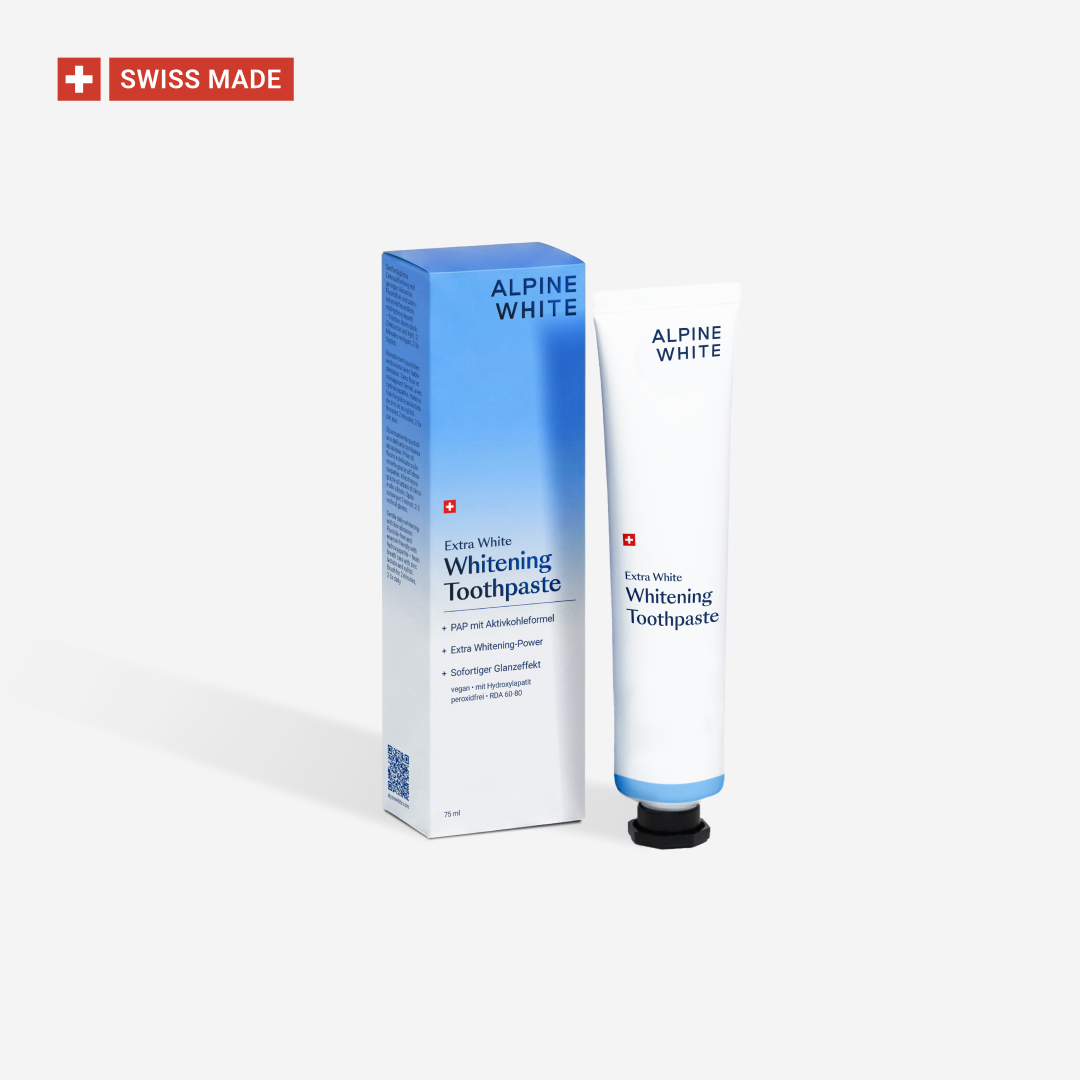
Folding box and tube ALPINE WHITE Extra White Whitening Toothpaste, “Swiss Made” note
4.7(69)

Whitening Toothpaste Extra White

€ 19.90

75 ml • € 26.53

Learn more

How often should you brush your teeth?

It is best to brush your teeth after every meal, and at least twice a day for at least two minutes. The plaque tablets mentioned at the start can help you check your work. They make any remaining plaque visible, so you can see where to brush again. Once your teeth are thoroughly clean, no discolouration will show on the tooth surfaces. These tablets are available at pharmacies.

Cleaning too often, or overdoing the care of your gums, does more harm than good. Being thorough matters more. Thorough cleaning means flossing once a day to clean between your teeth and keep them healthy. An interdental brush is a handy addition that makes cleaning the gaps between your teeth easier.

Mouthwash is not a substitute for brushing or flossing. It only supports your oral hygiene.

After acidic foods and drinks, wait at least twenty minutes before brushing. Acid attacks tooth enamel, and if you brush while it is in this vulnerable state, you are more likely to damage it.

Check the ingredients of your toothpaste too. Fluoride is essential, because it gives extra protection against tooth decay. Other substances, such as triclosan, are more harmful than helpful and do not need to be in a toothpaste. Find out here what to look for when buying toothpaste.

The right dental care for children

A child's teeth and mouth are still developing, so cleaning needs to suit their age. Use a children's toothbrush and children's toothpaste. The brush head of a children's toothbrush is softer and smaller, so plaque can be removed carefully. Children's toothpaste also contains less fluoride, because too much fluoride at a young age can lead to dental fluorosis.

Bad breath despite brushing regularly?

Do you have bad breath even though you brush regularly? To learn more about its causes, read this article. In short, fresh breath takes more than brushing. Remove the coating on your tongue with a tongue scraper or your toothbrush, and use dental floss to remove food from between your teeth. It also helps to see your dental hygienist regularly for a professional clean, which removes food debris from hard-to-reach places. If bad breath persists, speak to your dentist.

Dental care with Alpine White

With our dental care products, we want to give you optimal oral care and healthy teeth. Our products were developed and tested in Switzerland together with experts. The Whitening Toothpaste Extra White supports gentle tooth and oral hygiene at home, and our other products also care for your mouth and support your oral health.

A professional teeth clean at your dentist or dental hygienist complements your daily routine, with our products helping you maintain the results at home.

This might also interest you

Two smiling women against a white background, one in green top, the other in beige jacketDental Hygiene

Professional teeth cleaning with a dental hygienist

A visit to the dental hygienist does two jobs. Cosmetically, a professional teeth cleaning removes stains and plaque for a cleaner, brighter smile. Medically, it protects your gums and teeth, so they stay healthy for much longer. Here is how a scale and polish works, what it prevents and how to support it at home.

Hand reaches for a tin of white peppermint sweets on a wooden tableDental Health

Bad breath: causes and how to get rid of it

Almost everyone has bad breath now and then, and the causes of halitosis are many. The tricky part is that you cannot smell your own breath. From morning breath and onion breath to a sweetish or sour smell, bad breath comes in many forms. Here is how it develops and how to get rid of it.